
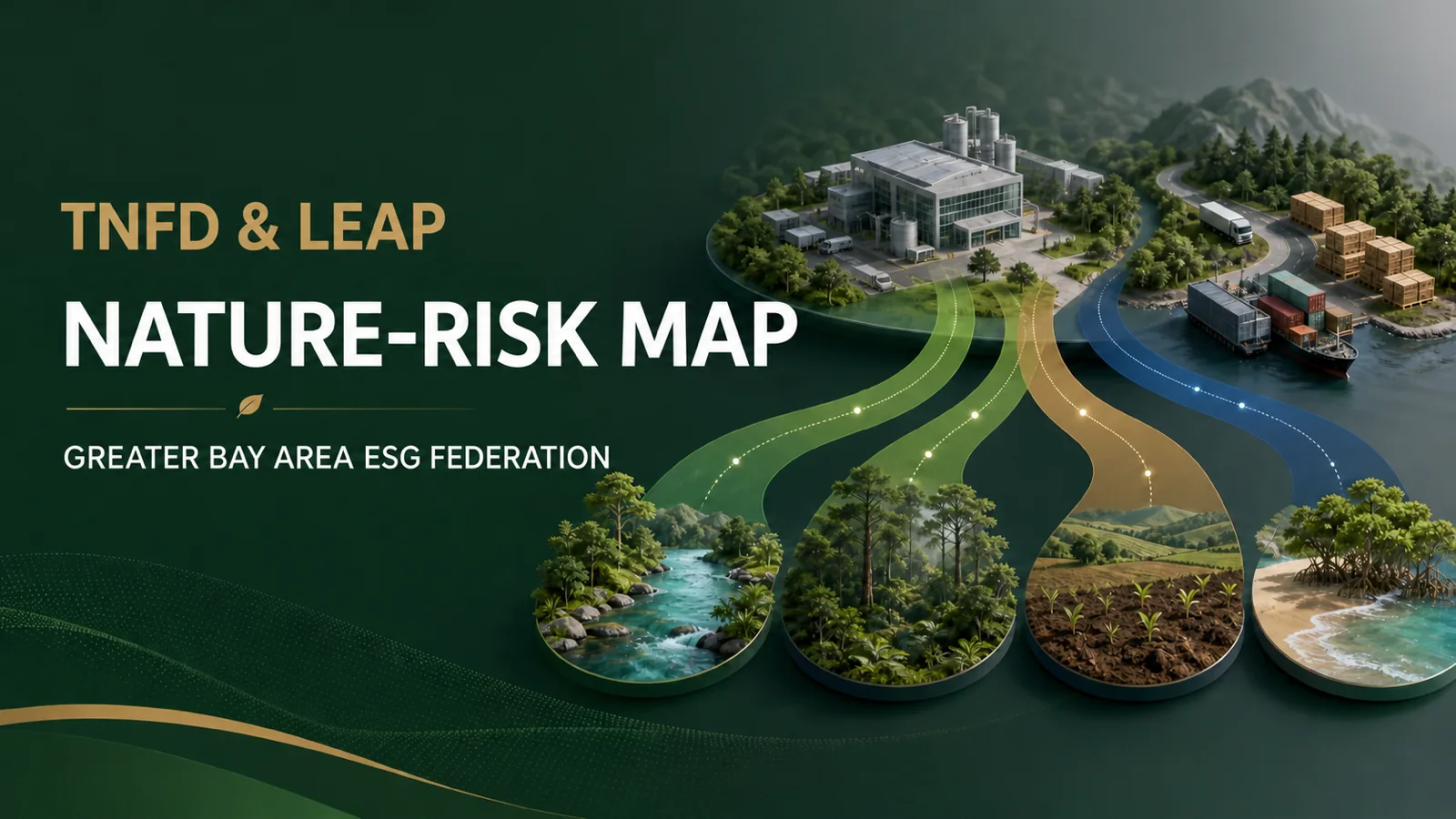
In brief: Begin with where the business and value chain interact with nature. Then use LEAP: Locate the interface, Evaluate dependencies and impacts, Assess risks and opportunities, and Prepare responses and reporting.
Nature-related issues vary greatly by location. Water dependence in one basin, land conversion near a sensitive ecosystem and commodity sourcing from another region cannot be understood from a corporate average alone. TNFD’s LEAP approach is designed for organisations of different sizes and sectors and can support due diligence even without a formal reporting obligation.
Locate priority interfaces with nature
Map operating sites and value-chain locations, then screen ecological sensitivity, water stress, land and commodity exposure. Prioritise locations where the organisation has high dependency, high impact or proximity to sensitive areas. Record data gaps rather than assuming an unknown location is low risk.
Evaluate dependencies and impacts
Identify ecosystem services the business relies on, such as water, flood protection, soil or pollination, and impacts such as pollution, extraction or habitat change. Consider scale, extent, condition and reversibility using appropriate evidence.
Assess business risks and opportunities
Translate dependencies and impacts into physical, transition and systemic risks, as well as opportunities. Examine operational disruption, cost, market access, finance, legal exposure and reputation. Use time horizons relevant to the location and business model.
Prepare response and reporting
Prioritise avoidance and reduction of negative impacts before restoration or offsets. Assign owners, actions, metrics and escalation. Disclosures should explain scope, methods, limitations and how nature-related information affects governance and decisions.
A practical implementation sequence
Run a first-pass screen across sites and key commodities, then choose a small number of priority locations for deeper assessment. Avoid beginning with a large global metric list that lacks location and decision context.
- Map sites, key suppliers, commodities and known locations.
- Screen ecological sensitivity and business dependence.
- Assess dependencies, impacts, risks and opportunities.
- Prioritise avoidance, reduction and management responses.
- Document scope, methods, gaps, metrics and governance.
For every step, retain the owner, source, reporting period, method, version, reviewer and known limitations. Estimates can be useful during transition, but they should never be presented as measured data.
Decision risks to control
- Starting with corporate averages and ignoring location.
- Treating biodiversity as only a conservation donation topic.
- Jumping to offsets before avoiding or reducing impacts.
Retain location lists, screening sources, dependency and impact assessments, stakeholder or expert input, risk translation, response decisions and data limitations. Respect sensitive ecological and supplier information.
Frequently asked questions
Is LEAP only for large listed companies?
No. It is designed for organisations of different sizes and can be applied proportionately to priority locations and value chains.
Must every supplier location be known first?
No, but location gaps should be recorded and prioritised where commodities or regions indicate potentially significant nature-related issues.
Are climate and nature risks the same?
They overlap but are not identical. Nature assessment also considers ecosystems, species, water, land and dependencies at specific locations.
What should the first output be?
A prioritised location and issue map, with assumptions, owners and a plan for deeper assessment and response.
Authoritative sources
- Taskforce on Nature-related Financial Disclosures Recommendations
- TNFD Guidance on the LEAP Approach
- GRI 3 Material Topics 2021
This article is for general information and education only. It is not legal, investment, financial, assurance, certification, compliance or other professional advice.