
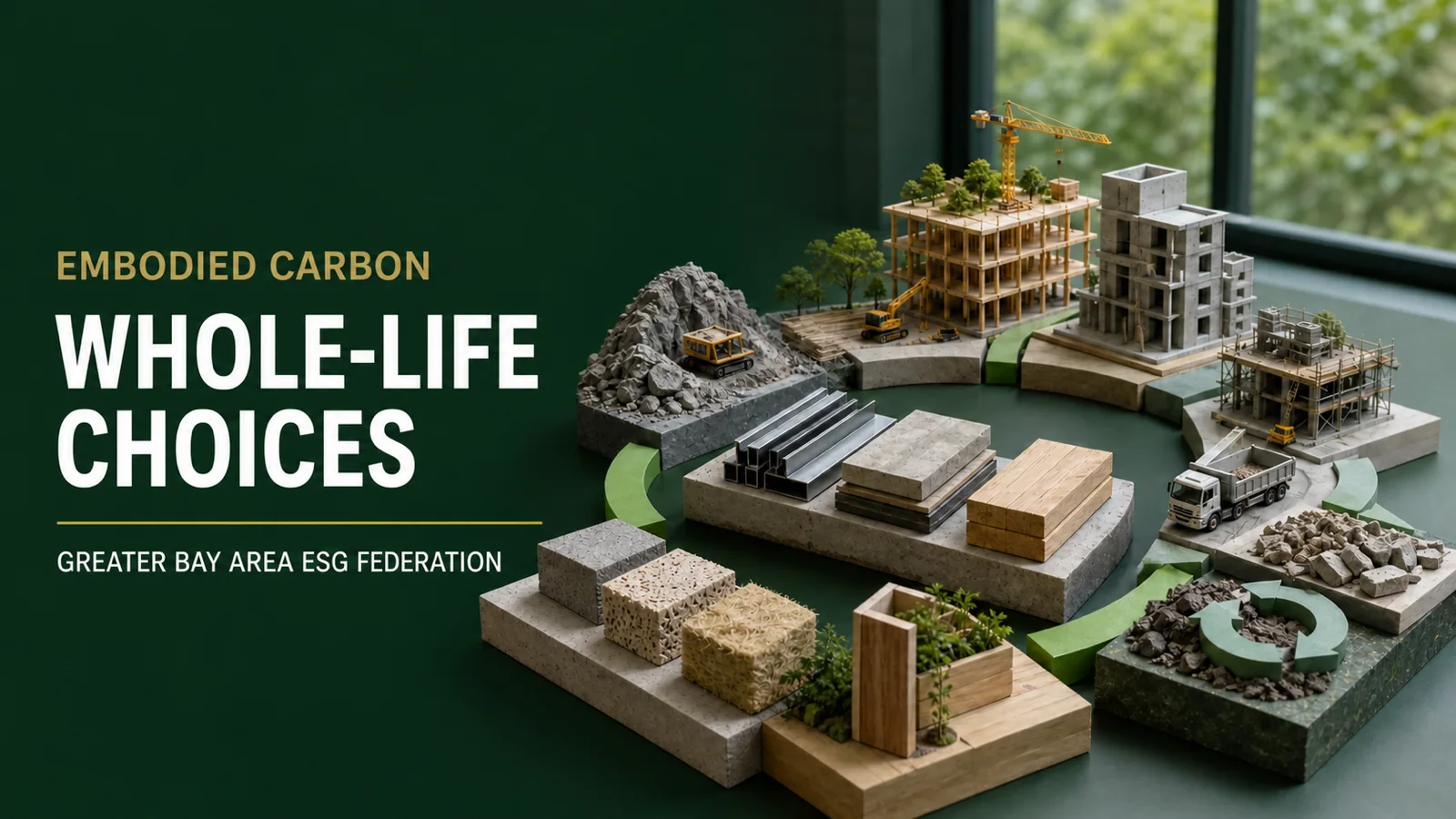
In brief: Embodied carbon covers greenhouse-gas emissions associated with materials and construction across relevant life-cycle stages. Meaningful comparison requires equivalent function, quantity, performance, service life and system boundaries.
Operational energy is only part of a building’s climate impact. Extraction, manufacture, transport, construction, maintenance, replacement and end-of-life decisions can also be significant. Designers and clients influence these impacts early, when structural systems, material quantities and performance requirements are still flexible.
Define the decision and boundary
Clarify whether the study supports concept design, product selection, procurement or reporting. State included life-cycle stages, building elements, study period and functional unit. Results with different boundaries should not be placed side by side without adjustment.
Reduce quantities before substituting materials
Efficient grids, reuse of structures, design optimisation and avoiding over-specification can reduce material demand. Substitution matters, but a lower-impact product may not compensate for unnecessary quantity or short service life.
Use comparable product and project data
Prioritise project quantities and credible product-specific information where available. Check geography, technology, data year, declared unit and life-cycle modules. Document estimates and the hierarchy used when specific data is unavailable.
Track design and procurement changes
Set a carbon budget and review it at design gateways. Record how substitutions, supplier changes, transport assumptions and construction waste affect the result. The final as-built assessment should not rely solely on an early design model.
A practical implementation sequence
Begin with the structural frame, envelope and other material-intensive elements. Compare realistic design options, identify quantity reduction opportunities and convert the selected approach into procurement requirements and change controls.
- Define the purpose, functional unit and life-cycle boundary.
- Establish material quantities and a carbon baseline.
- Test reuse, efficiency and design optimisation first.
- Compare equivalent products with credible data.
- Track substitutions and produce an as-built record.
For every step, retain the owner, source, reporting period, method, version, reviewer and known limitations. Estimates can be useful during transition, but they should never be presented as measured data.
Decision risks to control
- Comparing products with different functions or boundaries.
- Focusing on material labels while ignoring quantity.
- Using design assumptions as final as-built performance.
Retain models, bills of quantities, assumptions, data-source hierarchy, product declarations, transport and waste records, option decisions and change logs. State uncertainty and excluded stages so users can interpret the result.
Frequently asked questions
Is embodied carbon the same as operational carbon?
No. Operational carbon relates to energy used in operation; embodied carbon relates to materials and construction across relevant life-cycle stages.
Is a low-carbon material always the best option?
No. Check function, quantity, durability, maintenance, transport, replacement and the building system as a whole.
When should assessment begin?
Begin during concept design, when major systems and quantities can still change, then update through procurement and completion.
Can generic data be used?
Yes as a transparent interim source, with a documented hierarchy and replacement by project or product-specific data where material.
Authoritative sources
- UNEP Global Status Report for Buildings and Construction 2025-2026
- UNEP Building Materials and the Climate
- CIC Carbon Assessment Tool
This article is for general information and education only. It is not legal, investment, financial, assurance, certification, compliance or other professional advice.