
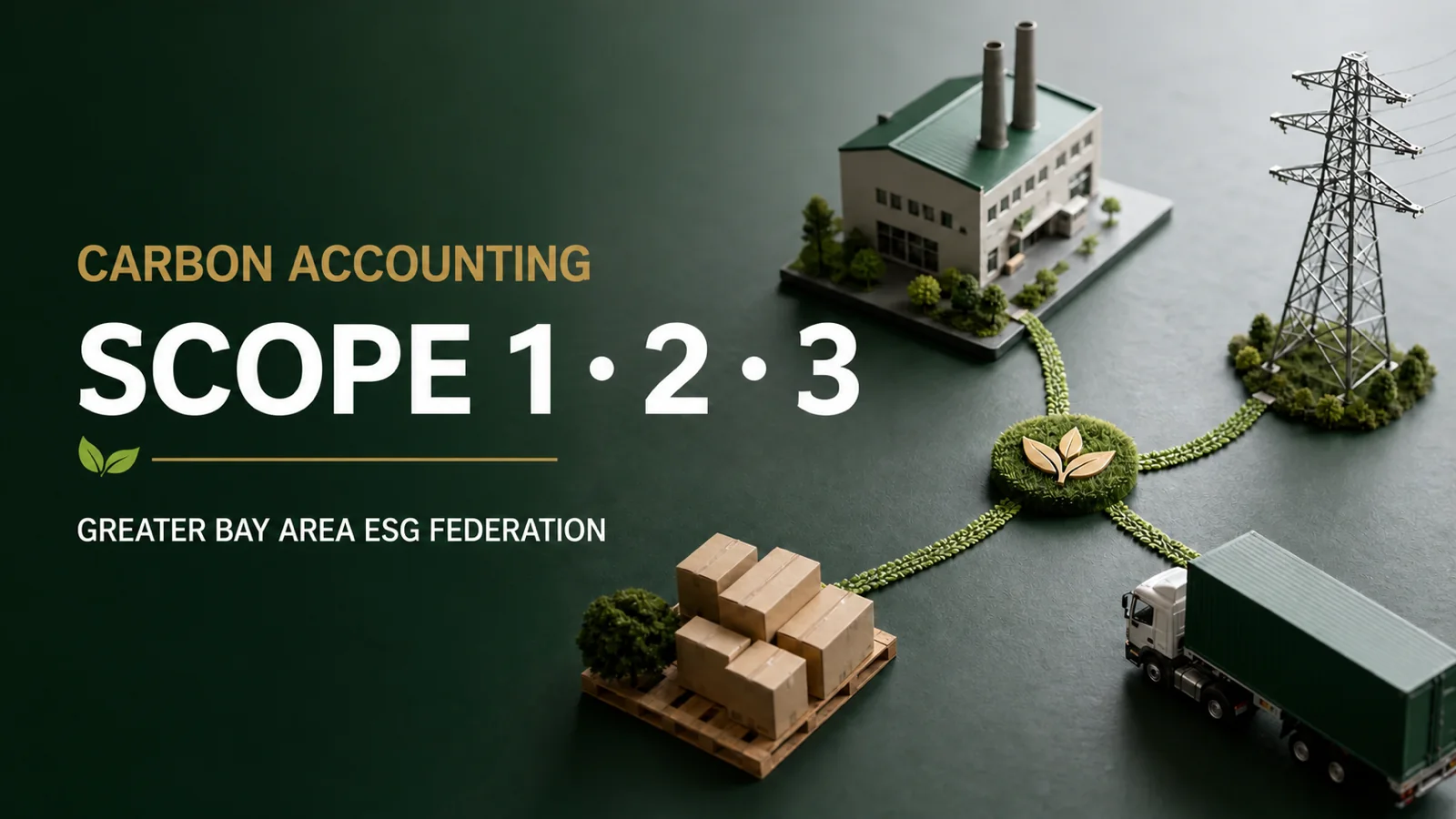
In brief: Scope 1 covers direct emissions from sources the company owns or controls. Scope 2 covers indirect emissions from purchased energy. Scope 3 covers other value-chain emissions. The categories only become useful when the organisation first defines its boundary, sources, methods and ownership.
A greenhouse-gas inventory is a management model of activities and emissions, not a list of utility bills. The GHG Protocol Corporate Standard provides the foundation for defining organisational and operational boundaries. A consistent base year and recalculation policy allow management to distinguish real performance changes from acquisitions, disposals, method changes or corrected errors.
Start with the organisational boundary
Choose and document the consolidation approach applied to subsidiaries, joint operations and controlled assets. Map legal entities, facilities and operating responsibility. Boundary decisions should be consistent with the stated methodology and reviewed when the organisation changes.
Scope 1 captures direct operational sources
Typical sources include fuel combustion, company vehicles, process emissions and refrigerant leakage. Build a source register with activity data, units, factors, owners and evidence. Small or irregular sources should not disappear simply because invoices are difficult to collect.
Scope 2 requires a clear electricity method
Purchased electricity, steam, heating and cooling sit in Scope 2. Where relevant, distinguish location-based and market-based results and document contractual instruments. Energy use and emissions are related but different metrics, so both units and conversion factors need control.
Scope 3 follows the wider value chain
Scope 3 includes upstream and downstream categories such as purchased goods, logistics, business travel, product use and investments. Screen all categories for relevance before prioritising data improvement. The largest source may sit outside direct operations, but estimation quality will vary.
A practical implementation sequence
Build the inventory from a source register, not from the final spreadsheet. Every line should connect an activity, period, unit, evidence file, factor and reviewer. Establish a base-year recalculation policy before organisational changes occur.
- Document the consolidation approach and entity boundary.
- Create a complete register of direct, energy and value-chain sources.
- Assign data owners and standard collection dates.
- Record factors, units, conversions and estimation methods.
- Set base-year recalculation and correction policies.
For every step, retain the owner, source, reporting period, method, version, reviewer and known limitations. Estimates can be useful during transition, but they should never be presented as measured data.
Decision risks to control
- Classifying emissions before agreeing the organisational boundary.
- Mixing energy consumption and carbon emissions units.
- Reporting a total without a source register or factor evidence.
Retain invoices, meter records, fuel logs, refrigerant service reports, travel data, supplier information, factor references and review notes. A change log should explain corrections and method updates so year-on-year movements remain interpretable.
Frequently asked questions
Are employee commutes Scope 1?
Normally no. Employee commuting is generally a Scope 3 category because the vehicles are not owned or controlled by the reporting company.
Is purchased electricity always Scope 2?
Purchased electricity used by the reporting organisation is generally Scope 2, subject to the inventory boundary and applicable method.
Must every Scope 3 category be measured precisely?
Screen every category, then prioritise material categories. Estimates may be used transparently while better activity or supplier data is developed.
When should a base year be recalculated?
Follow a documented policy for significant structural changes, methodology changes or material errors so comparisons remain meaningful.
Authoritative sources
- GHG Protocol Corporate Standard
- GHG Protocol Corporate Value Chain Scope 3 Standard
- HKEX Appendix C2 Environmental, Social and Governance Reporting Code
This article is for general information and education only. It is not legal, investment, financial, assurance, certification, compliance or other professional advice.