
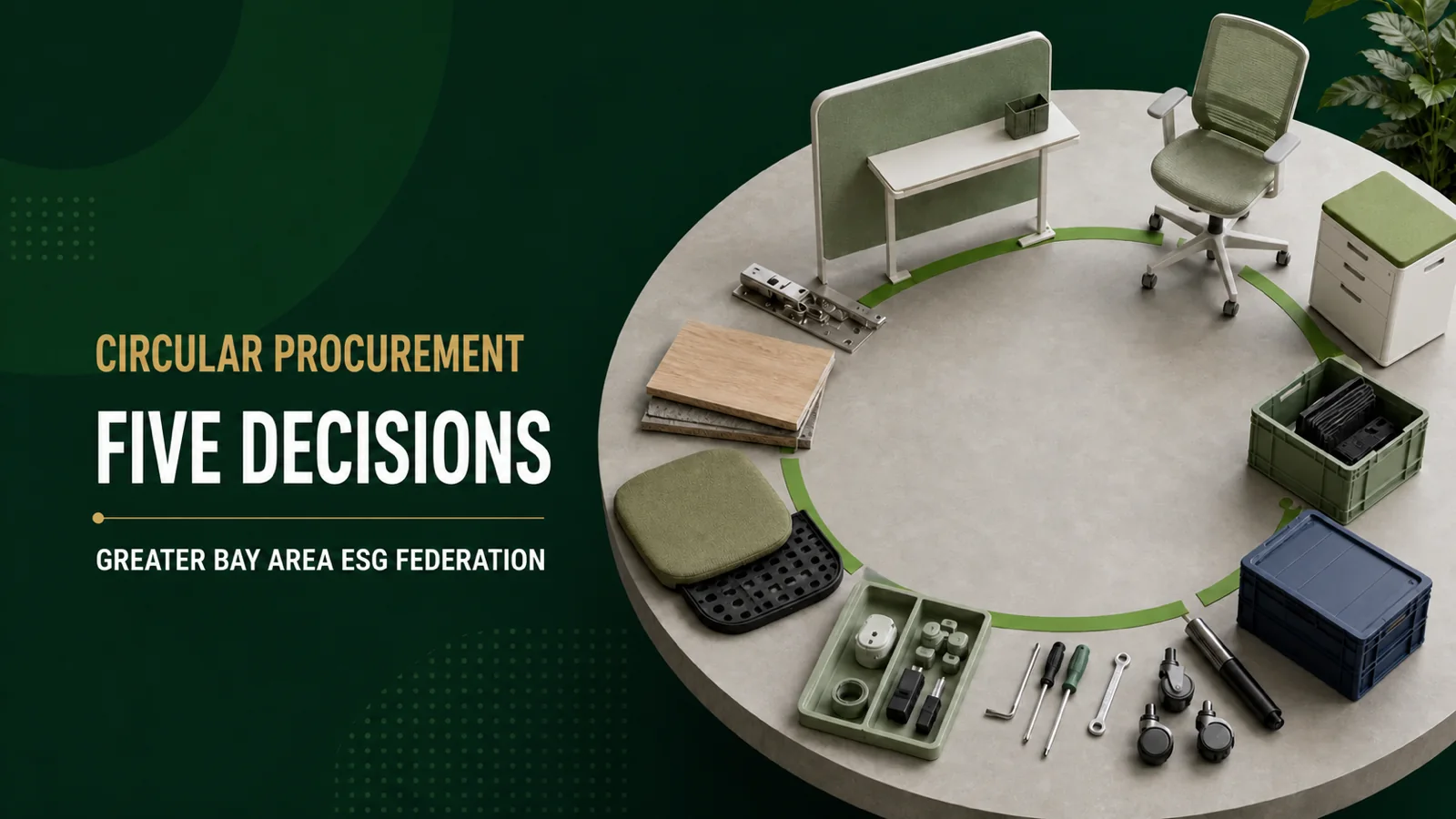
In brief: Circular procurement begins before product selection. Ask whether the need can be avoided, whether an existing asset can be used longer, whether the solution is durable and repairable, and whether materials or products have a credible next use at end of life.
Buying a product with recycled content may be helpful, but it does not by itself make procurement circular. Specifications determine material use, lifetime, repair options and recovery long before a purchase order is issued. Procurement therefore needs to work with users, finance, facilities and suppliers to compare function and total lifecycle value.
Question one: is a new purchase necessary?
Clarify the service or function required. Check existing inventory, sharing, refurbishment, redeployment and demand reduction. Avoiding unnecessary purchasing often reduces more material and cost than selecting a marginally improved new product.
Question two: will the solution stay in use?
Specify durability, modularity, warranties, spare parts, software support and repair information. Evaluate total cost of ownership, downtime and expected service life. A longer-lasting product can outperform a nominally green alternative that requires frequent replacement.
Question three: can ownership models change?
Consider leasing, product-as-a-service, performance contracts or supplier take-back where they create genuine incentives for maintenance and recovery. Review liability, data, service continuity and end-of-contract arrangements rather than assuming a new model is automatically better.
Questions four and five: what enters and what leaves?
Review material composition, recycled or renewable inputs, hazardous substances, packaging and evidence. Define end-of-life pathways and who is responsible. A take-back promise should identify the collection route, treatment destination and reporting evidence.
A practical implementation sequence
Select one high-volume category and rewrite the specification around function, lifetime and recovery. Invite suppliers to propose alternatives, then score lifecycle cost, environmental evidence and service performance together rather than adding a small green weighting at the end.
- Define the function before specifying a new product.
- Check reuse, repair, sharing and refurbishment options.
- Include durability, support and repair requirements.
- Compare ownership and service models with full risks.
- Require evidence for materials and end-of-life pathways.
For every step, retain the owner, source, reporting period, method, version, reviewer and known limitations. Estimates can be useful during transition, but they should never be presented as measured data.
Decision risks to control
- Equating recycled content with overall circularity.
- Buying efficient products that are difficult to repair.
- Accepting take-back claims without downstream evidence.
Keep the needs assessment, option comparison, specification, supplier evidence, lifecycle-cost model, award rationale and end-of-life records. Measure utilisation, lifetime extension, repair, recovery and avoided purchase where those indicators support decisions.
Frequently asked questions
Is the lowest-carbon product always the circular choice?
Not automatically. Compare function, lifetime, repair, material health, utilisation and recovery using consistent boundaries.
Can services be circular?
Yes, when contract incentives support maintenance, life extension and recovery, and the service does not simply shift impacts elsewhere.
What should a take-back clause include?
Specify eligible items, logistics, ownership, data handling, treatment routes, reporting evidence and responsibility if the provider changes.
Where should an SME begin?
Choose one repeat-purchase or high-waste category where users and suppliers can test revised specifications and measure outcomes.
Authoritative sources
- 香港資源循環藍圖2035
- OECD Guidelines for Multinational Enterprises on Responsible Business Conduct 2023
- UNEP Building Materials and the Climate
This article is for general information and education only. It is not legal, investment, financial, assurance, certification, compliance or other professional advice.